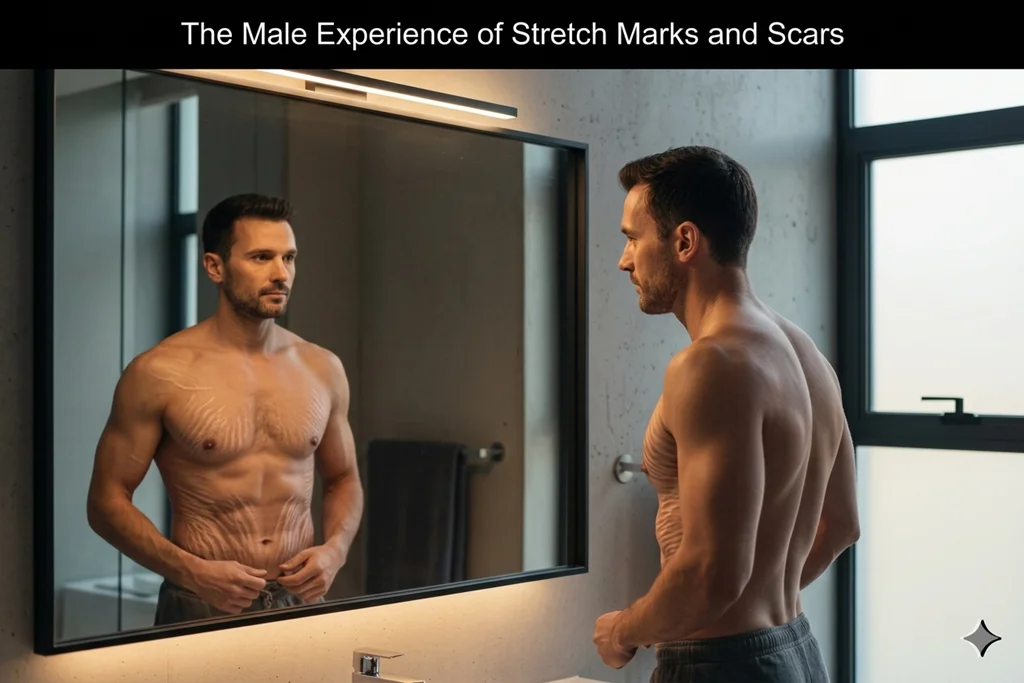

Editor’s Note: This blog post explores the devastating impact stretch marks can have on self-esteem and intimacy. The post illuminates the deep-seated emotional struggle associated with stretch marks. The connection between our physical self and our emotional well-being is undeniable. For many individuals, especially women, stretch marks are not merely cosmetic alterations; they are significant scars that can deeply impact self-confidence and intimacy. This powerful blog post, “How Stretch Marks Impact Confidence and Intimacy,” dives deep into this often-silenced struggle.
How Stretch Marks Impact Confidence and Intimacy: You Are Not Alone
That little voice in your head doesn’t just whisper. It screams right at the most vulnerable moment. As clothes come off, it hijacks your thoughts: “He is going to notice the stretch marks.” “I wish I could turn off the lights.” “What is he thinking right now?”
This isn’t just shyness. In fact, this is body image anxiety actively sabotaging your sexual connection. Understanding how stretch marks impact confidence and intimacy is the first step toward reclaiming your pleasure and freedom in the bedroom. The fear of being truly seen creates a wall between you and your partner. Consequently, it becomes nearly impossible to relax, stay present, and enjoy the connection you deserve.
Stretch marks are often seen as “scars” from a previous version of oneself. Research from the Cleveland Clinic on Body Dysmorphic Disorder confirms that perceived physical “flaws” lead to significant social anxiety and emotional distress. However, the impact on confidence isn’t really about the skin itself. Rather, it’s about the “story” you tell yourself about it. Healing begins with acknowledging that your body’s changes are a map of your life’s journey, not a list of its failures.
Furthermore, you are not alone in this struggle. Research shows that body image concerns affect millions of people in relationships. Moreover, partners are almost always far more focused on connection than on physical “imperfections.” If your stretch marks are holding your sex life hostage, this post offers you a practical path forward.
The Anatomy of Body Anxiety Around Stretch Marks and Intimacy
To begin with, let’s understand what happens in your mind and body during intimate moments. This anxiety becomes a cruel, self-fulfilling cycle. The fear of disconnection actually creates the very distance you dread. Specifically, this plays out in three destructive patterns.
Pre-Emptive Withdrawal
You start finding excuses to avoid sex. This avoidance isn’t a lack of desire for your partner. Instead, it’s a desperate attempt to avoid the vulnerability of being seen undressed. Over time, this withdrawal creates emotional distance that neither partner fully understands.
Mental Distraction During Intimacy
During sex, your mental energy shifts away from pleasure entirely. You focus on calculating angles, monitoring your partner’s gaze, and worrying about the visibility of your marks. Psychologists call this habit “spectatoring.” A Psychology Today article on body image and sexual satisfaction explains that you cannot be “in the moment” and “in the mirror” at the same time. As a result, arousal and pleasure evaporate instantly.
Misinterpreting Your Partner’s Reactions
You become a detective searching for proof of your own inadequacy. A casual glance, a moment of silence, or a certain touch gets filtered through a lens of shame. Your internal voice concludes, “They noticed. They must be disgusted.” In reality, your partner is almost certainly focused on you as a person, not on your skin.
Additionally, the Gottman Institute’s research on body-positive intimacy demonstrates that vulnerability and open communication actually strengthen emotional bonds. Therefore, the very thing you fear—being truly seen—can become the foundation for deeper connection.

How Stretch Marks Damage Confidence: The Social Ripple Effect
Beyond the bedroom, the impact of stretch marks on confidence and intimacy extends into everyday life. You might avoid the beach, the gym locker room, or even changing in front of a partner you’ve been with for years. That burning self-consciousness is not about the lines on your skin. Rather, it stems from the relentless societal message that you are imperfect, or worse, damaged.
This shame spiral often escalates into full social anxiety. As a result, you avoid pools, skip vacations, and decline intimate invitations. The longer this avoidance continues, the more power the anxiety gains. Fortunately, breaking the cycle is possible, and it starts with a few deliberate shifts.
For further reading on related body acceptance challenges, explore our post on Men Have Stretch Marks Too: A Guide to Body Confidence and Acceptance, which covers how these feelings cross gender lines.
Building the Communication Bridge: How to Talk to Your Partner
The single most powerful way to disarm shame is to discuss it openly with your partner. Secrecy gives anxiety its power. Honest communication, however, takes that power away.
- Initiate the conversation in a calm, neutral setting.
Choose a quiet, non-sexual moment. Be direct but vulnerable: “I love being intimate with you, but I feel incredibly vulnerable about my stretch marks. It’s a real source of anxiety, and sometimes I worry about what you think.”
- Tell your partner specifically how they can help.
Your partner isn’t a mind-reader. A loving partner genuinely wants to support you but needs guidance. For example, try saying, “It would mean the world to me if you told me I’m attractive more often. And perhaps you could focus your touch on areas I feel confident about, like my shoulders or my back.”
- Take ownership of your physical environment.
Control is a powerful antidote to anxiety. Set the stage for your own comfort deliberately. Use candles or dimmable lights for a soft, flattering glow. Keep a piece of clothing on that acts as a security blanket—a silky robe or a favorite top—while you build confidence gradually.
Building the Communication Bridge: How to Talk to Your Partner
The single most powerful way to disarm shame is to discuss it openly with your partner. Secrecy gives anxiety its power. Honest communication, however, takes that power away.
- Initiate the conversation in a calm, neutral setting.
Choose a quiet, non-sexual moment. Be direct but vulnerable: “I love being intimate with you, but I feel incredibly vulnerable about my stretch marks. It’s a real source of anxiety, and sometimes I worry about what you think.”
- Tell your partner specifically how they can help.
Your partner isn’t a mind-reader. A loving partner genuinely wants to support you but needs guidance. For example, try saying, “It would mean the world to me if you told me I’m attractive more often. And perhaps you could focus your touch on areas I feel confident about, like my shoulders or my back.”
- Take ownership of your physical environment.
Control is a powerful antidote to anxiety. Set the stage for your own comfort deliberately. Use candles or dimmable lights for a soft, flattering glow. Keep a piece of clothing on that acts as a security blanket—a silky robe or a favorite top—while you build confidence gradually.
Our deepest fear is not that we are inadequate. Our deepest fear is that we are powerful beyond measure.” — Marianne Williamson
Mindful Reconnection: Shifting Focus from Flaw to Feeling
The ultimate goal is to retrain your brain to be a participant in pleasure rather than a critic on the sidelines. These techniques help you rebuild confidence around stretch marks and intimacy step by step.
Sensory Focus Exercise
During intimacy, consciously choose one non-visual sensation to anchor your attention. For instance, focus on the scent of your partner’s skin, the feeling of their breath on your neck, or the sound of their heartbeat. Whenever your mind drifts toward anxiety, gently guide it back to that anchor sensation. With practice, this technique effectively interrupts the shame spiral.
Body-Positive Mantras Before Intimacy
Before undressing, repeat a simple, grounding phrase to reset your internal dialogue. Try the following: “My body is a landscape of my life and experiences” or “I am worthy of pleasure exactly as I am.” These affirmations work because they redirect your brain toward acceptance before anxiety takes hold.
Touch Therapy: A Solo Practice
Outside of a sexual context, begin to touch your own marks with care. Gently massage them with a moisturizing oil or lotion. This deliberate, non-judgmental touch helps your brain re-categorize these areas from “defects to hide” to “neutral, accepted parts of your body.” Consequently, stretch marks gradually lose their emotional charge.
“To love yourself is to allow yourself to be seen.” — Brené Brown
Supporting Your Skin Health to Rebuild Confidence After Stretch Marks
While the core work is internal and relational, caring for your skin’s health can also provide a meaningful boost to your confidence. Note: Always consult your doctor before starting any new supplement regimen.
Hydration: Hyaluronic Acid and Vitamin C Serums
Topical treatments cannot erase stretch marks entirely. However, keeping your skin deeply hydrated can significantly improve its texture and appearance. Hyaluronic acid is a hydration powerhouse, while vitamin C supports collagen production. Together, they can visibly improve overall skin quality over time.
Collagen Peptides
Adding a hydrolyzed collagen supplement to your daily routine may improve skin elasticity and hydration. This works by supporting your body’s natural collagen synthesis. Many users report noticeable improvements in skin texture within three to six months of consistent use.
Zinc and Silica
These minerals play a vital role in skin repair and collagen synthesis. You can find them in supplement form or through foods such as nuts, seeds, and whole grains. Including them in your diet actively supports the skin’s natural healing process.
Vitamin E
Known for its antioxidant properties, vitamin E supports skin health both internally and topically. You can take it as a supplement or apply pure rosehip oil directly to the affected area. Rosehip oil is also rich in vitamin A, which additionally aids skin regeneration.
When to Seek Professional Support for Intimacy-Related Body Anxiety
Sometimes, the emotional weight of stretch marks on confidence and intimacy runs deeper than self-help strategies alone can address. If anxiety is significantly disrupting your relationships, a therapist who specializes in body image or sexual health can provide powerful support. Cognitive Behavioral Therapy (CBT), in particular, has strong evidence for treating body dysmorphic concerns.
Additionally, if you experience symptoms like persistent avoidance, panic during intimacy, or severe depression related to your body image, professional guidance becomes essential. You may also find valuable related support in our post on The Psychological Cost of Hiding a Sexual Health Issue, which explores the emotional toll of keeping body-related struggles hidden.
Conclusion: Reclaiming Confidence and Intimacy After Stretch Marks
Your body tells a story. Its lines and marks are evidence of growth, survival, and change. Understanding how stretch marks impact confidence and intimacy is not about finding a cure. Rather, it’s about rewriting the story you tell yourself about your body—from one of shame to one of strength.
By communicating openly with your partner, practicing mindful reconnection, and caring for your physical and emotional health, you move from avoidance to acceptance. Furthermore, you move from self-criticism to self-compassion. Most importantly, you move toward the deep, present, pleasurable intimacy you genuinely deserve. You are not broken. You are beautifully, powerfully human.
Your body tells a story. Its lines and marks are evidence of growth, survival, and change. By taking these steps—to communicate, to reconnect, and to care for yourself—you aren’t just fixing a “problem.” You are embarking on a journey to rewrite the story you tell yourself about your body, from one of shame to one of strength, and ultimately, to one of pleasure.
Supporting Your Skin and Your Spirit: Supplements & Other Remedies
While the core work is internal and relational, supporting your skin’s health can provide a tangible boost to your confidence.
⚠️ Important Note: Always consult with your doctor before starting any new supplement regimen.
Essential Removers & Supplements for Skin Elasticity
- Hyaluronic Acid & Vitamin C Serums
- Benefits: While topical treatments can’t erase stretch marks, keeping skin deeply hydrated can improve its overall texture and appearance. Hyaluronic acid is a hydration powerhouse, and vitamin C is essential for collagen production.
- Where to buy: Amazon UAE
- Collagen Peptides
- Benefits: Adding a hydrolyzed collagen supplement to your daily routine may help improve skin elasticity and hydration over time by supporting your body’s natural collagen production.
- Where to buy: Amazon UAE
- Zinc & Silica
- Benefits: These minerals are vital for skin repair and the synthesis of collagen. They can be found in supplement form or in foods like nuts, seeds, and whole grains.
- Where to buy: Amazon UAE
- Vitamin E
- Benefits: Known for its antioxidant properties, vitamin E supports skin health. It can be taken as a supplement or applied topically in oil form (like pure rosehip oil, which is also rich in vitamin A).
- Where to buy: Amazon UAE